The growing dependence on information technology makes organizations increasingly vulnerable to disruptions, outages, and cyberattacks. A single IT failure can bring entire business processes to a standstill, disrupt supply chains, or permanently damage customer relationships. To address this, the International Organization for Standardization (ISO) released the revised version of ISO/IEC 27031 in May 2025. This standard provides guidance on ensuring ICT Readiness for Business Continuity (IRBC) and links information security with business continuity management.
Key Takeaways
ISO/IEC 27031:2025 was published in May 2025
Provides a framework for ICT readiness to support business continuity
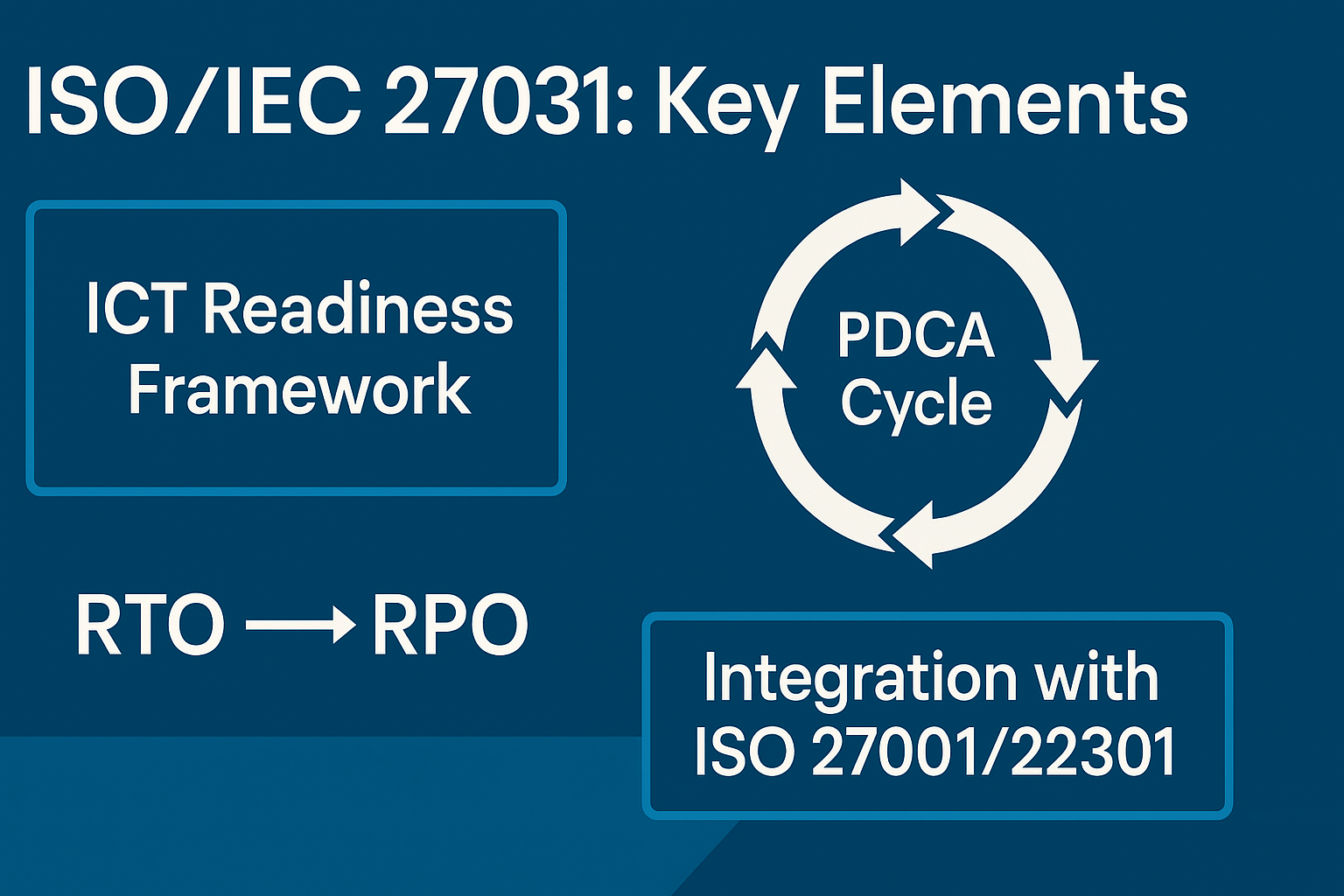
Based on the PDCA cycle (Plan-Do-Check-Act)
Strong integration with ISO/IEC 27001 (Information Security) and ISO 22301 (Business Continuity Management)
Focus on cloud services, cyber threats, and modern IT infrastructures
What is ISO/IEC 27031?
ISO/IEC 27031 is an international guideline that describes how organizations can prepare their information and communication technologies to ensure they reliably support business continuity in case of disruptions. The standard defines principles, processes, and measures to help ICT systems remain operational or recover quickly after an incident.
It bridges the gap between classic business continuity management and modern IT security. While ISO 22301 defines the general framework for business continuity, ISO 27031 specifies how ICT systems should be prepared, monitored, and restored.
Key Elements of the Standard
ICT Readiness Framework
The standard introduces a framework that helps organizations systematically prepare their ICT environments for outages and emergencies.
PDCA Cycle
ISO/IEC 27031 is based on the Plan-Do-Check-Act cycle. Organizations plan measures, implement them, monitor their effectiveness, and continuously improve.
Recovery Objectives
A central aspect is defining recovery objectives, such as Recovery Time Objective (RTO) and Recovery Point Objective (RPO). These determine how quickly systems must be restored and how much data loss is acceptable.
Focus on Modern Technologies
The 2025 version places special emphasis on cloud environments, virtualization, and external service providers, reflecting today’s IT infrastructure realities.
Why ISO/IEC 27031 Matters for GRC
The standard is closely tied to governance, risk, and compliance management.
Governance: Organizations must assign clear responsibilities for ICT readiness and establish leadership to actively manage cyber resilience.
Risk Management: ICT risks are better integrated into enterprise risk management. Threats such as cyberattacks, system downtime, or supplier failures can be assessed and mitigated more effectively.
Compliance: ISO/IEC 27031 complements standards like ISO/IEC 27001 and ISO 22301, enabling organizations to build consistent, auditable, and verifiable management systems.
Practical Benefits for Organizations
Faster, more structured response to IT disruptions
Improved resilience against cyberattacks and system failures
Seamless integration with information security and business continuity programs
Greater transparency and audit-readiness
Stronger trust among customers, investors, and regulators
Conclusion
ISO/IEC 27031:2025 is an important step toward making organizations more resilient against IT risks. With its clear structure, links to existing management systems, and focus on modern technologies, it provides a practical framework for integrating ICT resilience into GRC strategies. Organizations that adopt the new standard early will not only improve their responsiveness but also strengthen long-term competitiveness.
FAQ
What is the difference between ISO 27031 and ISO 22301? ISO 22301 defines the general framework for business continuity management. ISO 27031 specifies how ICT systems should be prepared and managed within that framework.
Is ISO/IEC 27031 certifiable? No, the standard serves as guidance. It complements certifiable standards like ISO 27001 and ISO 22301, which can be used for audits and external certification.
Which organizations should apply ISO 27031? Any organization that relies heavily on IT and digital processes. It is especially relevant for finance, manufacturing, energy, healthcare, and public sector organizations.
What does ICT readiness mean? ICT readiness refers to the ability of information and communication technologies to support business continuity and remain functional during crises.
What are the main benefits of applying the standard? Improved resilience, clear response processes in crises, stronger compliance, and enhanced stakeholder trust.
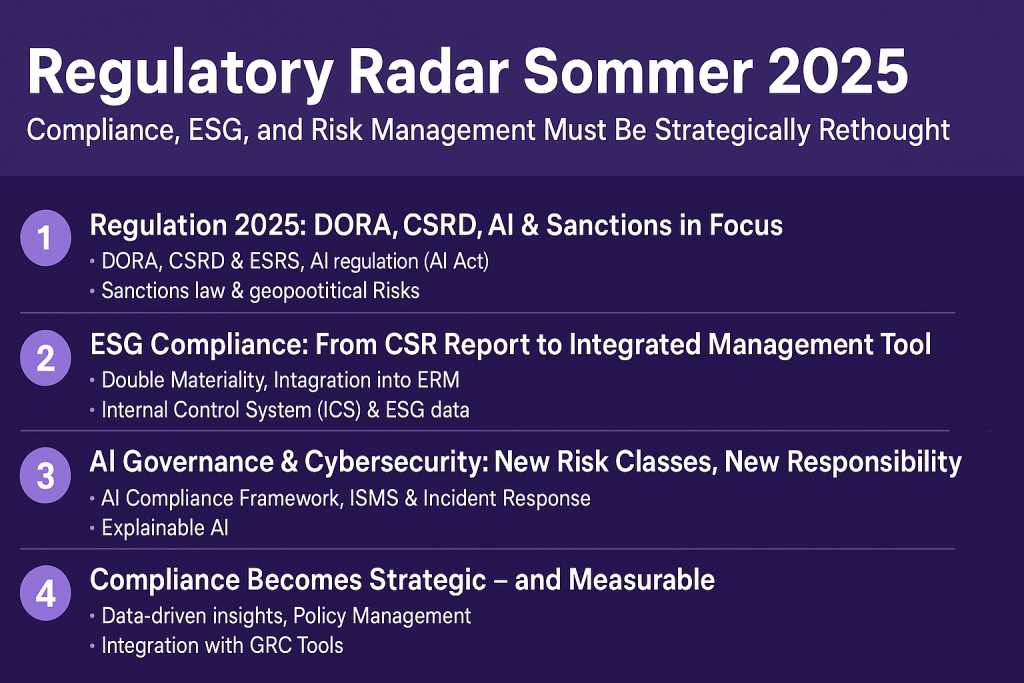
The Summer 2025 edition of the Regulatory Radar makes one thing clear: the regulatory landscape for companies—especially in the financial sector—is becoming increasingly complex. Between cyber risks, AI governance, ESG reporting obligations, and data protection regulations, organizations must not only stay compliant but act proactively.
Governance, Risk & Compliance (GRC) is evolving from reactive compliance tasks to strategic success factors. Organizations that modernize their risk management systems and build digital compliance architectures will gain a clear competitive edge.
1. Regulation 2025: DORA, CSRD, AI Act & Sanctions in Focus
Companies are facing a wave of new national and EU-level regulations. The most critical include:
DORA (Digital Operational Resilience Act) – strengthens IT resilience and mandates incident reporting
CSRD & ESRS – binding sustainability reporting standards across the EU
AI Act – governance of AI use based on risk classification and accountability
Sanctions and geopolitical risk – increasing demands on business partner screening and third-party risk management
Trending keywords: RegTech, real-time monitoring, control frameworks, business continuity.
2. ESG Compliance: From CSR Reporting to Strategic Management Tool
ESG is no longer a marketing label—it’s a regulatory, financial, and reputational imperative. Companies must:
Apply double materiality assessments
Understand SFDR requirements
Integrate ESG factors into Enterprise Risk Management (ERM)
Connect ESG data to internal control systems (ICS)
Strategic benefit: ESG becomes a driver of access to capital, brand value, and long-term viability.
3. AI Governance and Cybersecurity: New Risk Classes, New Responsibilities
As organizations adopt artificial intelligence in compliance, lending, and customer service, robust AI governance structures are needed. At the same time, cyberattacks are increasing in scale and complexity.
Priorities for 2025:
Develop a comprehensive AI compliance framework
Classify AI use cases according to EU risk categories
Integrate into ISMS (Information Security Management System)
Establish a functional incident response plan
Emerging focus: Zero trust architecture, cyber resilience testing, explainable AI, model risk governance.
4. Compliance Goes Strategic – and Measurable
Modern compliance management systems (CMS) are moving beyond policies and training. They deliver real-time risk insights, support automation, and ensure full auditability.
Key elements include:
Automated legal inventory tools
Workflow-based policy management systems
Anonymous whistleblowing platforms
Integration with GRC platforms and data governance solutions
Vision: Embedded compliance – scalable, measurable, and connected.
5. Recommendations for 2025 and Beyond
✔ Digitalize risk management – shift from static heat maps to real-time risk dashboards ✔ Embed ESG into GRC frameworks – sustainability is a core business imperative ✔ Integrate cyber risks into ERM – prevention, detection, and response as a unified chain ✔ Break down silos – connect legal, compliance, risk, ESG, and IT ✔ Automate reporting – real-time dashboards instead of annual reports
Conclusion
The Regulatory Radar Summer 2025 sends a clear signal: The era of fragmented risk and compliance functions is over. Organizations that embrace integrated, technology-driven, and strategic GRC approaches are not only staying compliant—but unlocking trust, innovation, and resilience.
FAQ – Regulatory Radar & GRC in 2025
What is the Regulatory Radar? A regular summary of the most relevant regulatory developments, particularly in finance, ESG, cybersecurity, and AI governance.
Why is 2025 a turning point? Because new regulations such as DORA, CSRD, and the AI Act are converging, forcing companies to rethink how they manage risk and compliance.
How does this affect compliance teams? Compliance becomes a cross-functional driver of strategy, requiring automation, real-time monitoring, and governance integration.
What’s the role of risk management? ERM bridges legal obligations, strategic goals, and operational resilience—and is becoming increasingly data-driven and agile.
What happens if companies fail to adapt? Regulatory penalties, loss of trust, reduced access to capital, and long-term reputational risks.
How should companies get started? Begin with a GRC maturity assessment, integrate regulatory updates into ERM, and invest in smart compliance technology.
For years, traditional risk management and operational resilience were treated as separate disciplines. While risk management focuses on identifying and assessing threats at a strategic level, resilience ensures business continuity in the face of disruptions.
But this separation is becoming a liability. In a world of overlapping crises—volatile supply chains, rising cyberattacks, geopolitical instability—isolated thinking is no longer effective.
The key lies in integration: risk management and resilience must be planned and implemented together.
1. Risk Management vs. Resilience – and Why the Distinction No Longer Matters
Risk management involves the systematic identification, assessment, and monitoring of potential threats. It answers:
What could happen?
How likely is it?
What would the impact be?
Resilience, by contrast, is about ensuring the organization remains operational during disruptions—through contingency plans, redundancies, and fast response mechanisms.
In theory, both disciplines complement each other. In practice, however, they often operate in isolation:
Different tools and systems
Separate teams with distinct goals
No unified risk evaluation or scenario planning
The result: Risks are recognized but not operationally addressed—or vice versa.
2. Why Integration Is Essential
a) Strategic risks must translate into operational readiness
Identifying a cyberattack as a top risk is not enough without concrete action: tested backup systems, trained response teams, and clear communication protocols.
b) Crises are multifaceted and don’t respect boundaries
A power outage affects IT, customer relations, legal obligations, and supply chain operations. Without coordination, responses are fragmented and ineffective.
c) Speed is the new currency of resilience
Modern threats escalate in real time. Only integrated structures—combining strategic foresight with operational agility—allow fast, aligned responses.
3. How to Connect Risk Management and Resilience
1. Establish a common language
Agree on shared terminology for “risk,” “impact,” “criticality,” and “scenario” across departments.
2. Use a unified platform
Consolidate risk and continuity data into one system to ensure transparency and eliminate duplication.
3. Conduct joint simulations
Risk managers and crisis teams should regularly run combined scenario exercises.
4. Rethink governance structures
Rather than reporting separately, create integrated dashboards for the board and executive management.
5. Promote a culture of collaboration
Operational departments must recognize that resilience is not an add-on—it is a leadership priority.
4. From Static Risk Reports to Dynamic Resilience
Traditional risk management is often backward-looking: annual reports, heat maps, risk categories.
Modern resilience, however, requires:
Real-time data (e.g. supply chain alerts, IT status, social media)
Forward-looking indicators
Organizational agility, communication, and adaptability
What’s needed is not separation—but a shared ecosystem where risk insights lead directly to readiness and action.
5. What Organizations Should Do Now
Action
Impact
Align risk and resilience strategies
Derive priorities systematically
Build cross-functional teams
Break down silos, leverage expertise
Implement integrated reporting
Provide clarity to leadership and regulators
Institutionalize scenario planning
Strengthen anticipation and decision-making
Foster shared ownership culture
Make resilience a strategic responsibility
Conclusion
In a volatile and complex world, isolated silos are no longer sustainable. Organizations that integrate risk management with operational resilience gain faster reaction times, better decision-making, and stronger long-term stability.
The future belongs to those who not only understand risk—but know how to respond with clarity and confidence.
FAQ – Risk Management and Resilience
What’s the difference between risk management and resilience? Risk management identifies and evaluates potential threats. Resilience ensures the organization can operate during and after those threats.
Why are these functions often separated? Historical growth, distinct responsibilities, and different reporting structures have led to functional silos—despite their shared goals.
What are the benefits of integration?
Faster crisis response
Shared understanding of risk scenarios
More efficient use of resources
Better decisions under pressure
How can companies get started? Launch a joint workshop between risk and crisis teams, define shared terms, and begin working with combined scenarios and reporting structures.
Is this relevant for small and mid-sized companies too? Absolutely. Any business facing operational complexity or regulatory scrutiny can benefit from integrated risk-resilience thinking.
What tools support this approach? Modern GRC (Governance, Risk, Compliance) and Integrated Risk Management (IRM) platforms that unify risk analysis, continuity planning, incident management, and communication.
In many organizations, governance is primarily associated with formal structures, compliance policies, and regulatory controls. However, effective governance goes beyond systems and rules—it requires a strong ethical foundation and shared values. It is the lived corporate culture that determines whether governance structures are truly effective or merely symbolic.
This article explains why culture is the essential foundation for good governance—not just in financial institutions but in any organization seeking resilience, integrity, and long-term success.
1. Governance Without Culture: A System Prone to Failure
Governance frameworks define roles, controls, and decision-making processes to ensure legality, accountability, and strategic alignment. But these frameworks only work when people actively support and internalize them.
Example: The 2008 financial crisis and the collapse of Credit Suisse were not caused by a lack of regulations. Rather, they were driven by a toxic risk culture and short-term thinking that ignored broader consequences. Compliance structures existed, but they were hollow.
Conclusion: Governance without a healthy culture is vulnerable to rule-bending, misconduct, and systemic failure.
2. What Is Corporate Culture—and What Makes It Effective?
Corporate culture encompasses the values, assumptions, and behavioral norms that shape how employees think and act. It is reflected in:
how mistakes are handled,
whether critical questions are welcomed or silenced,
how leadership communicates and makes decisions,
and whether ethical principles are respected under pressure.
An effective culture is characterized by:
Element
Governance Impact
Integrity
Decisions prioritize long-term responsibility
Transparency
Risks and conflicts are openly addressed
Accountability
Employees act responsibly beyond mere compliance
Openness to dissent
Critical thinking and dialogue are encouraged
Trust & respect
Reinforces collaboration and internal control
3. Risk Culture: The Litmus Test of Governance in Action
A core component of corporate culture is risk culture—the organization’s mindset and behavior regarding uncertainty, errors, and risk exposure.
In a mature risk culture:
Risks are not ignored but proactively surfaced.
Mistakes are used as learning opportunities.
Employees feel empowered to raise concerns—even upward.
The so-called “tone from the top” is crucial. If leadership communicates risk awareness but acts otherwise, the credibility of governance collapses.
What supports a healthy risk culture?
Risk-awareness training across all levels
Cross-level dialogue on critical topics
Psychological safety in raising issues
4. Culture Is Not Just a Finance Issue
While corporate culture is often discussed in the context of banks or insurance firms, it applies across industries:
Manufacturing: Without a strong safety culture, even the best technical standards can be undermined by shortcuts or pressure.
Healthcare: Patient safety depends on whether staff feel safe to report mistakes or risks.
Tech industry: Agility and innovation flourish in environments that tolerate failure and support learning.
Public sector: Anti-corruption efforts rely on lived integrity—not just codes of conduct.
Culture is the organization’s invisible operating system. It determines how formal rules are interpreted, adapted—or quietly ignored.
5. How to Actively Shape Corporate Culture
Unlike policies, culture cannot simply be „implemented.“ It must evolve and be nurtured over time. Key levers include:
a) Leading by Example
Leadership behavior sets the standard. Leaders who act according to declared values foster authenticity and credibility.
b) Operationalizing Values
Stated values like “responsibility” or “integrity” must be translated into tangible behaviors for different roles and contexts.
Example:
What does “integrity” mean in procurement decisions?
How is “accountability” demonstrated in customer service?
c) Enabling Feedback and Reflection
Culture thrives through open dialogue:
regular employee surveys,
facilitated discussions,
and culture-based metrics in reports.
d) Integrating Culture into Governance
Culture audits within internal controls
Culture-fit considerations in promotions
Ethical dimensions in risk assessments
6. Conclusion: Culture Is the New Compliance
In a world shaped by uncertainty, complexity, and shifting expectations, governance based solely on formal mechanisms is no longer sufficient.
Good governance depends on a solid cultural foundation.
Corporate culture is not a “soft” factor—it is a strategic resource. It strengthens trust, enables resilience, and supports responsible action in turbulent times. Organizations that treat culture as a core management concern—not an HR issue—will be more adaptive and credible in the years ahead.
FAQ – Corporate Culture and Governance
What is corporate culture? It refers to the shared values, behaviors, and informal norms that shape how people work, communicate, and make decisions in an organization.
Why is culture important for governance? Rules and policies only work if they are embedded in a culture of integrity, openness, and responsibility. Culture determines whether governance systems are followed in spirit or bypassed.
How is governance different from culture? Governance is formal (structures, roles, controls). Culture is informal (mindsets, behavior patterns). The latter determines how the former is applied in real life.
What is risk culture? Risk culture defines how people deal with uncertainty and potential threats. It includes how risks are perceived, discussed, escalated—or suppressed.
What are the signs of a weak culture?
Fear of speaking up
Tolerated rule-breaking
Top-down communication only
Ethical blind spots
Lack of reflection after failure
How can an organization shape its culture?
Consistent leadership behavior
Clear definition and translation of values
Honest conversations across hierarchies
Integration into audits, HR, and risk processes
Is this only relevant for financial institutions? Not at all. Any organization exposed to risk, responsibility, or human impact needs a strong culture—be it in health, tech, manufacturing, or government.
Can culture be measured? Yes, indirectly. Through surveys, incident reports, whistleblower data, retention rates, and internal assessments. Culture metrics are increasingly used in audits and strategy reviews.
The demands on companies to ensure their resilience against disruptions are growing rapidly. Traditional business continuity concepts are no longer sufficient in 2025 to meet the diverse regulatory and operational risks. The term operational resilience is becoming central to modern GRC strategies. But what exactly does it mean? And how can a GRC system help strengthen a company’s resilience in a structured way?
What is Operational Resilience?
Operational resilience refers to an organization’s ability to maintain or quickly recover critical business processes even in the face of significant disruptions. It’s not just about IT outages or natural disasters anymore, but also:
Cyberattacks
Third-party failures
Geopolitical crises
Supply chain disruptions
Regulatory shocks
Unlike traditional Business Continuity Management (BCM), operational resilience focuses not only on recovery but also on prevention, testability, and sustainable adaptability.
Key Regulations: DORA, NIS2 & More
New obligations are emerging, particularly in the financial and IT sectors:
EU DORA (Digital Operational Resilience Act): in force since January 2025, applies to banks, insurers, payment services, and IT providers
NIS2: Comprehensive cybersecurity and reporting requirements
ISO 22301: International standard for business continuity
BAIT, VAIT, KAIT: BaFin’s regulatory requirements for IT systems
These regulations demand institutionalized resilience, continuously tested, documented, and improved.
What must companies do in practice?
Identify critical business processes
Which processes are essential to business survival?
Define scenarios and tolerance thresholds
How long can a process fail before it becomes critical?
Capture risks and dependencies
Especially regarding third-party providers, IT services, and supply chains
Test and practice resilience
Simulations, penetration tests, crisis exercises
Document actions and integrate into the GRC system
Recovery plans, communication strategies, escalation processes
The Role of GRC Systems
A robust GRC system is the foundation of a resilient organization. It offers:
Central risk register mapping operational risks
Linking processes, assets, and third parties
Action tracking and escalation workflows
Audit trail for internal and external audits
Reporting for regulators, stakeholders, and management
Conclusion: Operational Resilience is the New BCM
In 2025, companies must think far beyond traditional emergency plans. Operational resilience means being prepared, responding quickly, and learning from each crisis. Investing in resilient structures and an integrated GRC system today ensures not only regulatory compliance but also the trust of customers, investors, and the public.
FAQ: Operational Resilience & GRC
What is the difference between business continuity and operational resilience?
BCM focuses on recovery plans. Operational resilience includes prevention, testing, and managing complex dependencies.
Which companies are affected by DORA?
All financial companies and IT service providers within the EU, including banks, insurers, fintechs, and cloud providers.
Is operational resilience only relevant for regulated companies?
No. SMEs and industrial firms also benefit from resilient structures in times of global uncertainty.
What role do third parties play?
A central one! Resilience always includes the supply and service provider chain. DORA mandates strict oversight of critical IT services.
How can a GRC tool help?
By providing centralized risk management, action tracking, scenario testing, and audit-proof documentation of all resilience components.
The year 2025 presents a complex risk landscape for global supply chains. From geopolitical tensions and climate-related disasters to evolving regulations and cybersecurity threats – businesses must stay ahead of the curve to maintain operational resilience.
Geopolitical Tensions and Trade Barriers
Recent trade conflicts, particularly the tariffs reintroduced by former President Donald Trump, are reshaping global supply chains. These tariffs increase production costs and force companies to rethink sourcing strategies. Industries like automotive and electronics are especially vulnerable due to their reliance on international suppliers.
Climate Disasters and Environmental Disruptions
Climate change is accelerating the frequency and severity of natural disasters. In early 2025, wildfires in the U.S. led to evacuations, power outages, and road closures, severely impacting supply networks. Experts warn that extreme weather events will increasingly disrupt ports and logistics hubs in cities like New York, Beijing, Boston, and Tokyo.
Rising Regulatory Pressures and Compliance Challenges
Organizations are facing a surge in global regulations focused on transparency, sustainability, and ethical sourcing. Laws such as the Dodd-Frank Act require companies to verify that their products are free from conflict minerals. Non-compliance can result in heavy penalties and reputational damage.
Cybersecurity Threats to Critical Infrastructure
With growing digital interconnectivity, supply chains are more exposed than ever to cyberattacks. Hacker groups are increasingly targeting logistics and infrastructure systems, causing significant downtime. Businesses must invest in robust cybersecurity protocols to mitigate these risks and maintain continuity.
Supplier Insolvencies and Financial Volatility
Global economic instability is driving supplier bankruptcies, which can trigger widespread disruption. Companies need to monitor the financial health of their partners closely and establish contingency plans or alternative suppliers to safeguard operations.
GRC Software: A Strategic Shield Against Uncertainty
Governance, Risk, and Compliance (GRC) software is becoming essential for modern risk management. These platforms provide real-time visibility into potential risks, streamline compliance workflows, and enable data-driven decision-making. Especially in uncertain times, GRC solutions empower organizations to build more resilient and agile supply chains.
Conclusion: Navigating 2025 with Resilience and Foresight
As supply chain risks multiply in 2025, proactive and strategic risk management is no longer optional – it’s a necessity. From geopolitical upheaval to regulatory tightening and cyber threats, businesses must evolve to stay competitive.
GRC software stands out as a critical enabler of supply chain resilience. By combining real-time risk intelligence, compliance automation, and cross-functional governance, it helps organizations turn uncertainty into a manageable—and even strategic—advantage.
What Trends Are Shaping Corporate Governance in 2025?
In 2025, sustainability in corporate governance is no longer just a trend but a key element. Companies are integrating sustainable practices into their core operations to ensure long-term success and fulfill social responsibility. At the same time, digital transformation plays a crucial role—from implementing data-driven decision-making to adopting new technologies. Another important trend is the growing focus on diversity and inclusion. Companies that foster diversity in their leadership benefit from varied perspectives while strengthening their culture and innovation capabilities. These trends reflect the urgent need to respond to a rapidly changing world and take strategic action to remain competitive.
Key Insights
Sustainability will be a key element of corporate governance in 2025.
Digital transformation is crucial for data-driven decisions and technological efficiency.
Diversity and inclusion offer companies creativity and strategic advantages.
Artificial intelligence and blockchain are revolutionizing corporate governance tools.
Integration of ESG principles is a must in the corporate strategy of 2025.
Regular review and adaptation of best practices ensure long-term competitiveness.
Sustainability as a Key Element
In 2025, sustainability will undoubtedly be the cornerstone of corporate governance. Companies are no longer just economically responsible but are increasingly adopting environmentally friendly and socially just business practices. This shift drives both brand loyalty and access to new markets. Implementing sustainable strategies allows companies to positively impact both the environment and society while securing a long-term competitive advantage. From resource conservation to supply chain management and product selection, all aspects aim to contribute to achieving the UN goals. Those who want to stay competitive in 2025 must act more sustainably than ever before.
The Role of Digital Transformation
Digital transformation plays a pivotal role in shaping corporate governance in 2025. Companies face a wide array of new technologies that not only increase efficiency but also open up entirely new ways to monitor and control business processes. The implementation of artificial intelligence and big data analytics enables well-informed decisions and more precise risk management. Additionally, blockchain offers unprecedented possibilities in terms of transparency and security. However, the technological shift is more than just an investment in new tools—it also requires a cultural shift within organizations. It’s about fostering a digital mindset and encouraging open exchange across all levels of hierarchy.
Significance of Digital Transformation
Implementation of AI and Big Data
Blockchain for transparency
Cultural change within organizations
What New Tools Support Effective Corporate Governance?
In 2025, innovative tools are essential for effective corporate governance. Artificial intelligence is revolutionizing data analysis, offering invaluable insights into complex business decisions. Blockchain technologies provide enhanced transparency and security by making data manipulation virtually impossible. This innovation is particularly valued for improving traceability of information. Cloud-based solutions offer unmatched flexibility, allowing companies to remain agile in a constantly changing environment. Using these tools helps businesses work efficiently and respond proactively to challenges.
Artificial Intelligence for Data Analysis
Artificial intelligence (AI) is revolutionizing data analysis in corporate governance and offering unprecedented opportunities for companies in 2025. AI can efficiently process large volumes of data and detect patterns that would otherwise remain hidden. Moreover, AI systems are capable of making accurate predictions and supporting informed decisions. Companies leveraging this technology enjoy a significant competitive advantage by responding to market changes more quickly and effectively. Transparency and security are enhanced through precise data analysis, leading to stronger stakeholder trust. Those who recognize and implement AI’s potential lay the foundation for future-ready corporate governance.
“Artificial intelligence is revolutionizing data analysis, offering precise predictions and enhancing transparency.”
Blockchain for Transparency and Security
The revolution of corporate governance is imminent, and in 2025, blockchain plays a central role in ensuring transparency and security in business operations. The decentralized nature of this technology reduces data manipulation and helps prevent fraud. Companies use blockchain to manage stakeholder information efficiently and build trust. Especially in combination with other digital tools like artificial intelligence, blockchain opens up new opportunities to increase efficiency and compliance. A transparent system based on traceable and secure transactions is key to successfully implementing corporate governance in the modern business world.
Use of blockchain technology
Improved transparency and security
Enhanced compliance efficiency
Trust through traceable transactions
Cloud-Based Solutions for Flexibility
In 2025, cloud-based solutions are bringing fresh momentum to corporate governance. They offer unmatched flexibility, which is essential for companies to respond quickly to market changes and design efficient processes. Especially in terms of data availability and real-time analysis, they are invaluable. Companies can access up-to-date data, make agile decisions, and thus increase competitiveness. Additionally, cloud-based services support collaboration among international teams, further boosting efficiency. In an era where adaptability is key to success, these solutions prove indispensable. They represent the future of corporate management and align with ongoing digitalization and the demand for greater flexibility.
What Are the Key To-Dos for Companies in 2025?
In 2025, companies face the exciting challenge of enhancing their corporate governance with a focus on sustainability and technology integration. A key to-do is the integration of ESG principles (Environmental, Social, Governance) into corporate strategy to meet growing expectations from investors and society. Additionally, training and development of leadership is essential to stay up-to-date with the latest trends and effectively implement innovative solutions. Finally, companies should optimize their risk management strategies by leveraging modern tools and technologies to proactively identify and mitigate risks. These steps not only secure market position but also promote long-term sustainability and growth.
Integration of ESG Principles
In 2025, the integration of ESG principles will be more central than ever in corporate management. Sustainability, social responsibility, and good corporate governance form the foundation for future-oriented action. Companies that embrace these principles benefit not only from a better image but also from economic success. Integrating ESG into company-wide strategies requires clear communication and assigned responsibilities to achieve goals efficiently. The challenge is to embed ESG concerns into everyday operations and create lasting value.
Training and Development of Leadership
In the ever-evolving world of corporate governance, leadership training and development is an indispensable element. 2025 emphasizes not only strengthening technical skills but also promoting competencies in sustainable action and diversity. Continuous adaptation to digitized work environments calls for a new learning culture. It’s about creating an environment where knowledge is openly shared and leaders act as role models to spread best practices throughout the organization. Ultimately, well-informed and adaptable leadership figures are the ones who successfully navigate companies and set the course for future challenges. Investing in human capital has never been more crucial.
Optimizing Risk Management Strategies
In 2025, optimizing risk management strategies is a top priority. Companies must adapt to rapidly changing conditions and proactively identify potential risks. Effective risk management is key not only to being better prepared for challenges but also to securing competitive advantages. Technological tools like artificial intelligence and big data play a vital role in this. They enable more precise risk analysis and help develop strategies that ensure both short-term and long-term business success. Companies should act risk-aware and implement flexible solutions to manage unexpected disruptions.
How Can Companies Continuously Improve Corporate Governance?
To continuously improve corporate governance in the dynamic business world of 2025, companies need strategic approaches. A central aspect is the regular review and adaptation of best practices. This includes keeping up with current trends and legal requirements. Furthermore, promoting a culture of open communication can strengthen collaboration between teams and departments, contributing to problem-solving and innovation. Establishing feedback loops between companies and stakeholders is also crucial. These provide new perspectives and enable sustainable decisions. Such measures allow companies to not only enhance their governance standards but also strengthen and expand their long-term competitiveness.
Key Aspects
Benefits for Companies
Regular Review
Increased flexibility
Open Communication
Strengthened innovation
Feedback Loops
Sustainable decision-making
Regular Review and Adaptation of Best Practices
In 2025, corporate governance is more dynamic than ever, making regular reviews and updates of best practices essential. Companies must constantly evaluate their governance strategies to effectively integrate sustainability, tech innovation, and an inclusive leadership culture. This not only keeps them agile but also optimizes competitiveness and market reputation. Implementing structured evaluations, with clearly defined goals and feedback mechanisms, strengthens the organizational backbone and builds stakeholder trust. Ultimately, this adaptability is what drives companies forward and prepares them for future challenges.
Promoting a Culture of Open Communication
A culture of open communication is key to successful corporate governance in 2025. Companies need to create an environment where employees feel safe and valued to share their opinions. Transparency plays a crucial role here. Regular meetings and platforms for exchanging ideas help build a shared understanding and trust. Leaders must encourage feedback and listen actively to drive innovation. Promoting open communication supports not only management but also improves the overall work environment and satisfaction of everyone involved.
Establishing Feedback Loops with Stakeholders
In 2025, establishing feedback loops with stakeholders becomes a critical element of successful corporate governance. Companies should ensure ongoing, open, and constructive dialogue with their stakeholders. This requires not only a modern technological infrastructure but also a willingness to respond to stakeholder needs and concerns. Regular feedback rounds help identify areas for improvement and create a reliable basis for strategic decisions. This allows companies to become more agile and adaptable in a dynamic business world. Building trust through transparent communication strengthens stakeholder relationships and fosters long-term collaboration.
FAQ
What role does sustainability play in corporate governance in 2025? In 2025, sustainability is an indispensable key element of corporate governance, as companies integrate sustainable practices to ensure long-term success and social responsibility.
Why is digital transformation important for corporate governance? Digital transformation is vital as it enhances efficiency through new technologies such as AI and Big Data, enabling innovative monitoring and control processes.
What new tools effectively support corporate governance? Artificial intelligence revolutionizes data analysis, blockchain ensures more transparency and security, and cloud-based solutions offer unmatched flexibility.
What are the most important actions for companies in 2025? Key actions include integrating ESG principles, training and developing leadership, and optimizing risk management strategies.
How can companies continuously improve corporate governance? Companies should regularly review and adapt best practices, promote a culture of open communication, and establish feedback loops with stakeholders.
The term GRC stands for governance, risk management and compliance. It can be described as a comprehensive set of capabilities that assists an organisation in achieving its objectives by ensuring fairness and integrity at all levels. The governance section encompasses the organisational activities which essentially include roles, responsibilities and expectations of the individuals who hold management positions as well as stakeholders. Risk management pertains to how well an organisation is prepared to address and mitigate both foreseeable and unforeseeable risks. Compliance refers to the organisation’s adherence to relevant laws and regulations, bylaws, organisation’s internal policies including those related to security controls.
Other domains of GRC
While governance, risk management, and compliance are the core areas of focus in GRC as the term implies, the significance of GRC is evident in a number of other interconnected areas of an organisation including IT governance, finance and audit, human resources, operations and supply chain to name a few. By being influenced by GRC, IT governance primarily relies on apposite frameworks, procedures, and policies which ensure that the organisation aligns with its objectives and compliance requirements. It is evident that the entire spectrum of finance and auditing within an organisation is profoundly influenced by GRC since the latter through different mechanisms such as internal control systems and auditing practices helps the organisation pass the test of transparency, accuracy and compliance with the relevant laws and regulations. GRC also holds significant relevance in various areas of operations and supply chain management, including product quality control, supply chain sustainability and vendor management. Moreover, the functions of human resources of an organisation can also be impacted positively by GRC, where the latter influences tasks that fall within the remit of human resources including employee diversity and inclusion, conduct, ethics, and the well-being of the employees.
The inevitable link between risk management and business continuity management
Risk management is often considered the heart of GRC. While the task of risk management is to mitigate or tackle problems, business continuity management obliges an organisation to stick to its advanced plan and act in accordance with it in situations where the organisation faces the worst possible results. The more robust risk management practice an organisation inculcates into its overall management system, the better, judicious, and measured planning and preparation it can come up with in dealing with unwanted results of its own activities, cyber-attacks, natural disasters, pandemics, etc. To put it differently, strong risk management in place helps an organisation understand what areas it should prioritise in its business continuity management in the event of any looming challenges. Business continuity management on the other hand acts as a strong weapon in mitigating risks. Risk management and business continuity management are so interdependent and considering them in silo may cause the organisation harm.
To effectuate business continuity management, organisations require overall monitoring and testing, and cross-functional collaboration on a consistent basis hence the absence of any risk management strategy in place and/or any flawed or inaccurate risk management can sink the organisation. The unforeseen recent demise of the two US banks (Silicon Valley Bank and Signature Bank) and a Swiss bank (Credit Suisse) due to poor risk management is a wake-up call for organisations not only within the financial industry but also in other industries such as health, food, and more, regardless of the organisation’s size.
Successful GRC implementation
Organisations are obligated to consider GRC components through various mechanisms in order to ensure smooth business operations and prevent any controversy regarding the functionality of their organisation’s GRC. The benefits of adopting a GRC strategy are enormous, and it would certainly not be an exaggeration to say that organisations lacking a well-defined GRC strategy in place are more likely to face collapse compared to those that do. Regarding the key to a successful well-defined GRC strategy, Joanna Grama, director of cybersecurity and IT GRC programs for EDUCAUSE said: “Implementing a framework will never be successful unless the organisation’s culture evolves to support GRC activities.”
There may be other ways to successfully implement GRC in an organisation, however, choosing GRC software tools, has been proven to be the most effective approach.
The digital transformation has fundamentally changed the landscape of Governance, Risk, and Compliance (GRC). Companies face new challenges arising from technological advancements, globalization, and changing regulatory requirements. In this whitepaper, we discuss how the GRC market has evolved and the role of innovative solutions like Zazoon in helping businesses navigate modern GRC challenges.
1. The Evolution of the GRC Market
1.1. Growing regulatory requirements
In recent years, numerous countries and industries have tightened their regulatory requirements to ensure transparency, integrity, and stability of businesses and financial markets. This development has led companies to continuously adapt and update their GRC strategies.
1.2. Globalization and interconnectedness
The globalization and interconnectedness of businesses lead to increased complexity in the GRC field. Companies must be able to understand and comply with country- and industry-specific regulations and guidelines while efficiently and effectively managing their international business activities.
1.3. Technological advancements
The rapid progress of technologies such as cloud computing, artificial intelligence (AI), and big data has created new opportunities and challenges in the GRC field. Companies must adapt and learn to effectively use these technologies to optimize their GRC processes and meet the demands of an ever-evolving digital landscape.
1.4. Data protection and cybersecurity
The increasing digitization of business processes and the growing importance of data have made data protection and cybersecurity central topics in the GRC field. Companies must ensure the integrity of their systems and the security of their customer data while simultaneously complying with legal data protection requirements.
2. The Role of Innovative GRC Solutions
2.1. Automation and efficiency
Innovative GRC solutions, like Zazoon, enable companies to efficiently manage their compliance, risk, and control requirements by reducing manual tasks and unstructured workflows. Through automation and centralized data management, companies can save time and resources and minimize human error.
2.2. Integration and flexibility
Modern GRC solutions provide an integrated platform that allows for effective management of various aspects of GRC, such as risk management, internal control systems, policy management, data protection, process management, supplier management, and ESG. A flexible and adaptable GRC solution supports companies in adapting to changing regulatory requirements and business environments without affecting their existing processes and systems.
2.3. Data analysis and decision-making
Innovative GRC solutions enable companies to effectively process, analyze, and derive valuable insights from large volumes of GRC-related data. By utilizing advanced data analysis techniques and visualization tools, companies can make informed decisions and optimize their risk management and compliance strategies.
2.4. Scalability and cloud computing
Modern GRC solutions offer scalable infrastructures and cloud computing options, enabling companies to effectively manage their GRC processes and adapt to growing demands. Cloud-based GRC solutions provide flexibility and scalability while meeting security and data protection requirements.
The digital transformation has fundamentally changed the GRC landscape and created new challenges for businesses. To be successful in this dynamic environment, companies must utilize innovative GRC solutions like Zazoon to help them efficiently and effectively manage their compliance, risk, and control requirements. With the right GRC solution, companies can optimize their processes, make informed decisions, and successfully adapt to constantly changing regulatory requirements and market conditions.
Your path to success
We invite you to learn more about the benefits of Zazoon and discover how our GRC solution can help you master the challenges of digital transformation. Contact us today to learn more and schedule a personal demo appointment. Let’s work together to shape your path to GRC success!
Environmental consciousness has become a major non-financial factor for businesses over the past few decades. The term ‘ESG’ entailing environmental, social, and governance factors, is employed to weigh how far companies have progressed and will be progressing in the future on all these determinants of their sustainability. The score of their sustainability does play a vital role for the investors in the process of their investment screening.
ESG relevancy for Business
While the other two determinants, social and governance of companies’ sustainability are in no way to be assumed less important, the environment is of the essence. Environmental factor has been able to gain more traction in the business world due to the mass awareness of climate change and global warming. Environmental factors do not affect only businesses but also our society, country as well as the world at large. The number of business industries that are being affected directly or indirectly by the consequences of climate change, is rising briskly. Such rapid environmental changes have been worrying many established businesses in the market along with the small ones. It has been found in a study that the U.S. alone could lose USD 520 billion across 22 sectors due to global temperature rise.
The concern as regards climate change and global warming has become a key factor for investors. In less than two decades, ever since the United Nations Environment Programme (UNEP) published a report ‘A Legal Framework for the Integration of Environmental, Social and Governance Issues into Institutional Investment’, in the year of 2005, ESG investing which is known as socially responsible investing has evolved into a USD 35 trillion industry. According to the money managers who oversee one-third of the total U.S. assets under their management, assets managed in portfolios labeled ‘ESG’ are expected to reach USD 53 trillion by 2025. (Bloomberg Intelligence, ESG assets may hit USD 53 trillion by 2025, a third of global AUM, published on: 23 February 2021)
The above figures manifestly show the growing desire of investors to create a positive impact on society, the country, and the world at large through their investments. These figures also reveal an exponential sense of ethics and fiduciary responsibility amongst the investors.
Such inclination of the investors obliges businesses to score well in ESG rating. A systematic and long-term plan can help them score well. It will also help them to see where they stand in the market in comparison with their peers as regards the sustainability of their businesses.
The ‘Green Blueprint’
Businesses may opt for a ‘Green Blueprint’ that will be premised upon ‘zero tolerance’ against any business activity that is detrimental to our environment, and will entail the below:
compliance with the national and international laws and regulations relating to environmental issues (different measures have been taken at the national, regional, and international level to tackle the climate crisis, such as the European Parliament has recently voted to set a 2035 deadline for zero-emissions cars and vans which is being seen by many as a huge step forward for climate action, air quality and the affordability of electric vehicles. Green group Transport & Environment called on EU environment ministers to confirm the effective end date for sales of new combustion engines when they meet on 28 June 2022. (Transport & Environment, EU Parliament backs 2035 end date for combustion engine cars, published on 8 June 2022));
creating consumer awareness of climate change and global warming which would drag the consumers towards green products (McKinsey research shows that more than 70 percent of customers would pay an additional 5 percent for a green product if they were satisfied that it met the same standards as a non-green alternative);
low-carbon business strategy;
less dependency on the natural resources than its peers;
having apt financial arrangements to deal with rising costs that ensue from climate change.
The proposed ‘Green Blueprint’ can help businesses become more sustainable and be well ahead of their peers in the market.
Closing thoughts
In an age where environmental consciousness has become a paramount concern, the significance of ESG (Environmental, Social, and Governance) factors cannot be overstated. While social and governance elements hold their own importance, the environment takes center stage due to escalating awareness of climate change and its global implications. The rapid and widespread impacts of environmental shifts on businesses and society have prompted a surge of concern among investors. This has driven the growth of ESG investing, with assets under management reaching staggering figures, underscoring a growing ethical responsibility among investors to make a positive societal impact.
This growing investor inclination compels businesses to prioritize high ESG scores, necessitating long-term strategies aligned with sustainability. A ‘Green Blueprint’ emerges as a potential solution, emphasizing strict compliance with environmental laws, fostering consumer awareness, adopting low-carbon strategies, resource efficiency, and prudent financial planning for climate-related costs. Embracing such a blueprint can empower businesses to lead in sustainability and outpace competitors, forging a path towards a more environmentally conscious and resilient future.